
Why Use Licensed Engineers in Texas Projects
Over 45 percent of American adults mistakenly think all engineers are licensed to handle critical projects. This misunderstanding can lead to costly errors and serious risks, especially when public safety is at stake. Choosing a Licensed Engineer is not just a formality but a legal and professional safeguard. Unpacking what sets these professionals apart clears up confusion and helps you make confident choices for your next project.
Table of Contents
- Licensed Engineers: Definition And Common Misconceptions
- Types Of Engineering Licenses In Texas
- Regulatory Requirements For Texas Projects
- How Licensed Engineers Safeguard Safety And Quality
- Legal And Financial Risks Of Unlicensed Work
- Comparing Licensed Versus Unlicensed Engineering Services
Key Takeaways
| Point | Details |
|---|---|
| Licensed Engineers are essential for public safety. | They adhere to strict regulatory frameworks that ensure projects meet high standards of technical competence and ethical responsibility. |
| Licensure requires a comprehensive process. | Professionals must have accredited degrees, relevant work experience, and pass rigorous examinations to obtain their license. |
| Engaging unlicensed engineers poses significant risks. | Using unlicensed practitioners can lead to legal complications and financial liabilities due to potential project failures. |
| Always verify an engineer’s licensing status. | Before hiring, check their credentials through the state board to ensure they are qualified and compliant. |
Licensed Engineers: Definition and Common Misconceptions
A Licensed Engineer represents a highly trained professional who has met rigorous standards of education, experience, and professional competence. According to the National Society of Professional Engineers, a Professional Engineer (PE) is an engineering professional who has earned a specialized license to practice engineering, signifying a high standard of competence and ethical practice.
To become a Licensed Engineer, professionals must navigate a comprehensive process that goes far beyond basic academic credentials. Licensing criteria established by professional boards typically require candidates to complete a four-year engineering degree from an accredited program, gain substantial professional work experience, and pass rigorous state-administered examinations. This multilayered approach ensures that only highly qualified individuals receive the professional engineering license.
Common misconceptions about Licensed Engineers often stem from misunderstandings about their specialized role. Many people mistakenly believe that all engineers are automatically licensed, or that any engineering graduate can immediately practice independently. In reality, the licensure process is selective and demanding. Licensed Engineers must demonstrate not just technical knowledge, but also professional judgment, ethical standards, and a commitment to public safety. They are legally authorized to stamp and approve critical engineering documents, perform independent professional services, and take direct responsibility for engineering work that could impact public infrastructure and personal safety.
Pro Tip: Before hiring an engineer for your Texas project, always verify their current professional licensing status through the state board’s official website to ensure you’re working with a fully qualified professional.
Types of Engineering Licenses in Texas
Texas offers a comprehensive framework for professional engineering licensure across multiple specialized disciplines. The Texas Board of Professional Engineers and Land Surveyors provides licensure for Professional Engineers (PEs) in critical fields including civil, electrical, environmental, mechanical, and structural engineering. Each of these license types represents a distinct professional pathway with unique qualifications and responsibilities.
To obtain an engineering license in Texas, candidates must navigate a rigorous process that goes well beyond basic academic credentials. Licensure requirements emphasize accredited educational backgrounds, typically preferring degrees from recognized bodies like EAC/ABET. The comprehensive licensing process ensures that engineers demonstrate not just theoretical knowledge, but practical expertise and professional competence in their specific engineering discipline.
The primary engineering license types in Texas include:
- Civil Engineering License: Focuses on infrastructure design, transportation systems, and public works projects
- Structural Engineering License: Specialized in designing buildings, bridges, and ensuring structural integrity
- Mechanical Engineering License: Covers design and implementation of mechanical systems and equipment
- Electrical Engineering License: Concentrates on electrical systems, power distribution, and complex electrical infrastructure
- Environmental Engineering License: Addresses environmental protection, sustainability, and regulatory compliance
Pro Tip: When hiring an engineer in Texas, always request to see their current professional license and verify its status through the official Texas Board of Professional Engineers website to ensure you’re working with a fully qualified professional.
Here’s a summary of engineering license types in Texas and their core responsibilities:
| License Type | Core Focus | Example Projects |
|---|---|---|
| Civil | Infrastructure and public works | Transportation networks, water systems |
| Structural | Building and bridge safety | High-rise buildings, overpasses |
| Mechanical | Mechanical systems and equipment | HVAC installations, manufacturing lines |
| Electrical | Power and electrical systems | Electrical grids, lighting plans |
| Environmental | Environmental protection | Wastewater treatment, pollution control |
Regulatory Requirements for Texas Projects
The Texas engineering landscape is governed by stringent regulatory frameworks designed to protect public safety and ensure professional competence. The Texas Engineering Practice Act mandates strict guidelines that define how engineering services can be legally performed, establishing clear boundaries for professional practice across the state. This comprehensive legislation ensures that only qualified, licensed professionals can design, plan, and oversee critical infrastructure and construction projects.
Under these regulations, licensed engineers are the only professionals legally authorized to perform or offer engineering services to the public. This requirement is not merely a bureaucratic formality, but a critical safeguard that ensures all public works and significant construction projects are designed and constructed under the direct supervision of a fully qualified professional engineer. The licensing requirements encompass multiple layers of verification, including:
- Comprehensive educational background verification
- Rigorous professional examination
- Demonstrated work experience
- Ongoing professional development
- Ethical standards compliance
The regulatory framework extends beyond simple credential checking. Licensed professionals must adhere to specific legal requirements that govern every aspect of their engineering practice. These regulations cover everything from initial project conception to final implementation, ensuring that public safety remains the paramount consideration in all engineering endeavors. Projects ranging from residential constructions to complex infrastructure developments must meet these exacting standards, with licensed engineers serving as the primary guarantors of quality and safety.
Pro Tip: Always request and independently verify a Texas engineer’s current professional license number before initiating any project, as this simple step can protect you from potential legal and safety risks.
How Licensed Engineers Safeguard Safety and Quality
Licensed Engineers serve as critical guardians of public safety, implementing comprehensive protective measures that go far beyond standard professional practices. Licensure represents a profound commitment to protecting public health and welfare, ensuring that every engineering project meets the highest standards of technical competence and ethical responsibility. These professionals are uniquely qualified to prepare, sign, seal, and submit engineering plans that directly impact community infrastructure and individual safety.
The safety protocols implemented by licensed engineers involve multiple layers of rigorous verification and risk management. Professional engineers conduct extensive technical assessments, structural analyses, and comprehensive risk evaluations that anticipate potential challenges before they become critical issues. Their specialized training allows them to identify subtle structural vulnerabilities, design fail-safe mechanisms, and develop contingency plans that protect both immediate project requirements and long-term community resilience. These professionals apply advanced mathematical modeling, structural analysis techniques, and predictive technologies to create solutions that prioritize human safety above all other considerations.
Moreover, licensed Professional Engineers in Texas bear direct responsibility for protecting public welfare, which translates into meticulously documented work processes and transparent decision-making protocols. Their license represents more than a credential – it symbolizes a legally binding commitment to maintaining the highest professional standards. Licensed engineers must continuously demonstrate technical expertise, ethical conduct, and a proactive approach to risk mitigation. This includes regular professional development, staying current with evolving building codes, technological innovations, and safety regulations that protect community infrastructure.
Pro Tip: Request a detailed portfolio and professional references when hiring an engineer, focusing on their track record of successful project completions and demonstrated commitment to safety standards.
Legal and Financial Risks of Unlicensed Work
Licensing requirements fundamentally protect public interests by preventing unqualified individuals from misrepresenting their technical capabilities. Unlicensed work represents a significant legal and financial minefield that can expose property owners, contractors, and project managers to substantial risks. When unqualified individuals perform engineering services without proper credentials, they create potential scenarios of catastrophic liability that can result in devastating financial and legal consequences.
The legal ramifications of unlicensed engineering work are particularly severe in Texas. The Texas Engineering Practice Act strictly mandates that only licensed professionals can legally perform engineering services, with violations subject to significant legal penalties. These penalties can include substantial monetary fines, potential criminal charges, and permanent prohibition from practicing engineering. Property owners who knowingly engage unlicensed engineers may find themselves equally liable, potentially facing:
- Complete project invalidation
- Massive repair and reconstruction costs
- Potential personal injury lawsuits
- Voided insurance coverage
- Potential criminal negligence charges
Beyond immediate legal risks, unlicensed work creates long-term financial vulnerabilities that can dramatically exceed initial cost savings. Improperly designed structures, miscalculated load-bearing specifications, or substandard infrastructure can lead to catastrophic failures that result in exponentially higher remediation expenses. Licensed engineers provide comprehensive risk mitigation through professional liability insurance, standardized documentation, and adherence to rigorous safety protocols that protect both the client and the broader community.

Pro Tip: Always request and independently verify a Texas engineer’s professional license number through the official state licensing board before initiating any project, as this simple verification can save you from potentially devastating legal and financial repercussions.
Comparing Licensed Versus Unlicensed Engineering Services
Licensure represents the professional gold standard in engineering services, creating a definitive benchmark that separates qualified professionals from unverified practitioners. Licensed engineers bring a comprehensive suite of credentials, expertise, and legal authorization that unlicensed service providers simply cannot match. The fundamental difference extends far beyond paperwork – it represents a profound commitment to technical excellence, public safety, and professional accountability.
The key distinctions between licensed and unlicensed engineering services are stark and consequential. Licensed engineers possess legally recognized credentials that authorize them to prepare, sign, seal, and submit official engineering plans. The Texas Engineering Practice Act mandates strict guidelines ensuring that only qualified professionals can legally perform engineering services, creating a critical protective mechanism for public infrastructure and individual safety. The comparative differences include:
- Legal Authorization: Licensed engineers have official state permission
- Liability Coverage: Professional liability insurance protects clients
- Technical Expertise: Rigorous testing and continuous education requirements
- Documentation Standards: Ability to produce legally valid engineering documents
- Risk Management: Systematic approach to identifying and mitigating potential hazards
Unlicensed services inherently represent a high-risk alternative that can compromise project integrity, safety, and legal compliance. While they might appear cost-effective initially, the potential for catastrophic failures, legal complications, and long-term financial risks far outweigh any short-term savings. Licensed engineers bring comprehensive quality assurance, proven methodological approaches, and a legally recognized commitment to maintaining the highest professional standards. Their training encompasses not just technical skills, but also ethical considerations, risk assessment, and a holistic understanding of engineering’s broader societal implications.
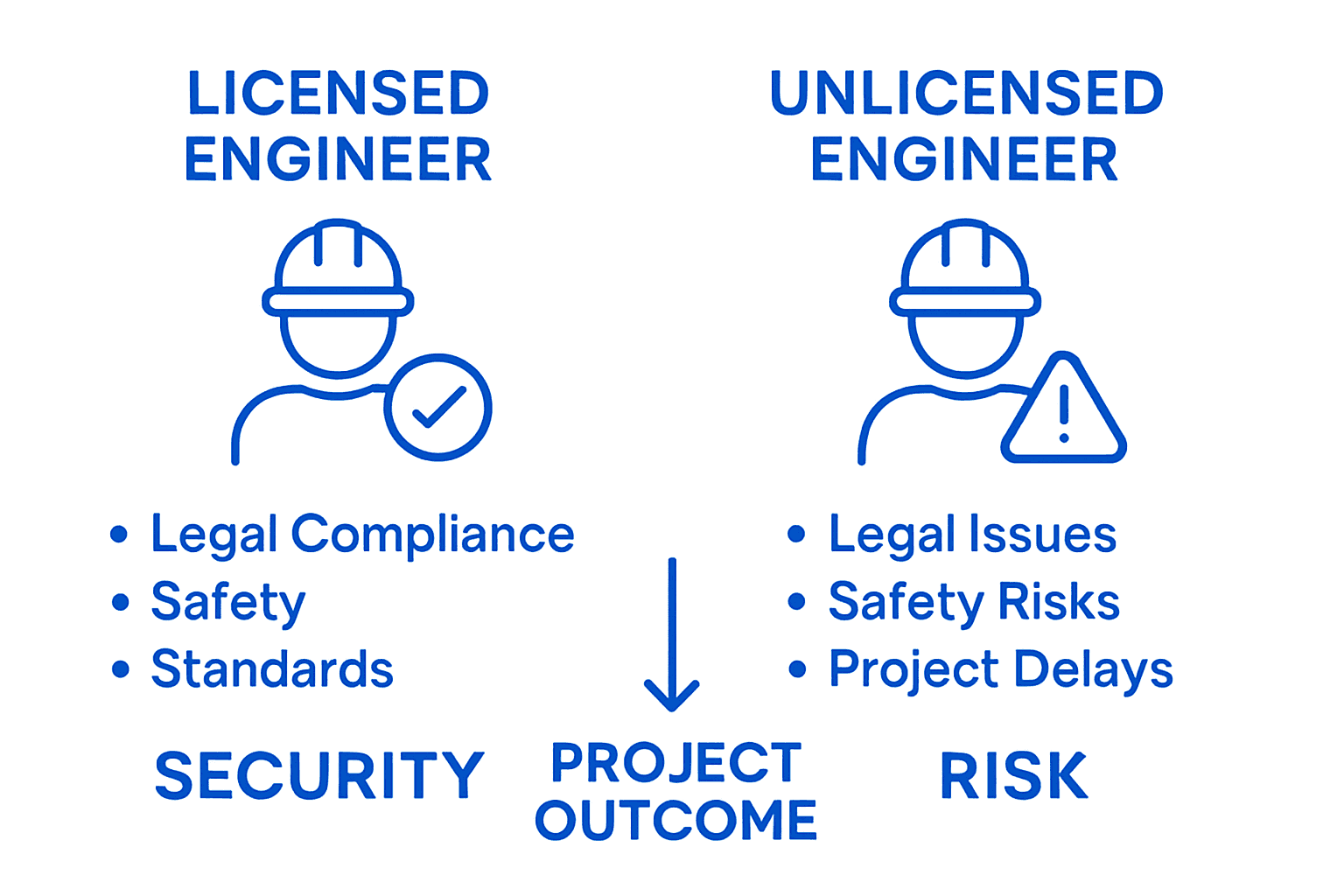
To better understand the impact of licensure, compare essential aspects of licensed versus unlicensed engineering:
| Attribute | Licensed Engineer | Unlicensed Engineer |
|---|---|---|
| Legal Authority | Can sign and seal documents | Lacks legal approval rights |
| Client Protection | Covered by liability insurance | No professional coverage provided |
| Professional Oversight | Regular audits, ongoing education | No mandated oversight or updates |
| Project Outcomes | Meets safety and quality codes | Increased risk of code violations |
Pro Tip: Always request and verify a professional engineer’s current license status directly with the Texas Board of Professional Engineers before engaging their services, ensuring complete legal and technical compliance.
Secure Your Texas Project with Trusted Licensed Engineers
When your project’s safety and compliance are on the line, using licensed engineers in Texas is not optional — it is essential. As the article highlights, only licensed professionals possess the legal authorization, ethical responsibility, and technical expertise to ensure your infrastructure meets strict state regulations and public safety standards. Whether you need structural inspections, construction plans, or expert forensic investigations for incidents like flood damage or grading issues, working with a qualified engineer protects you from costly legal and financial risks.

Discover peace of mind by choosing professionals who understand the intricacies of Texas licensing requirements and carry the authority to stamp and approve your engineering documents. Our team specializes in licensed engineering services across Houston, Dallas, Austin, San Antonio, and other Texas cities. Act now to avoid project delays and liabilities. Visit https://texaslicensedengineers.com to get started or explore expert insights in our Uncategorized Archives. Take the first step in safeguarding your investment and ensuring unmatched quality for your residential or commercial project today.
Frequently Asked Questions
What is the role of a licensed engineer in Texas projects?
Licensed engineers in Texas are responsible for ensuring public safety and compliance with legal standards in engineering projects. They have the authority to prepare, sign, seal, and submit engineering plans, safeguarding both infrastructure integrity and community welfare.
How can I verify if an engineer is licensed in Texas?
You can verify an engineer’s licensing status by checking the official website of the Texas Board of Professional Engineers. This resource allows you to ensure that the engineer has the necessary credentials to perform engineering services.
What are the risks of hiring an unlicensed engineer for a project?
Hiring an unlicensed engineer poses significant legal and financial risks, including project invalidation, repair costs, liability for personal injury, and potential legal penalties for both the engineer and the property owner.
What types of engineering licenses are available in Texas?
Texas offers various engineering licenses, including those for civil, structural, mechanical, electrical, and environmental engineering. Each license type mandates specific qualifications and responsibilities tailored to that engineering discipline.
Recommended
- Role of Engineers in Texas Projects: Ensuring Safety and Compliance – Texas Licensed Engineers | Residential & Commercial
- Defining Civil Engineering Services in Texas Homes – Texas Licensed Engineers | Residential & Commercial
- Greater Houston – Texas Licensed Engineers | Residential & Commercial
- Greater Dallas – Texas Licensed Engineers | Residential & Commercial
